
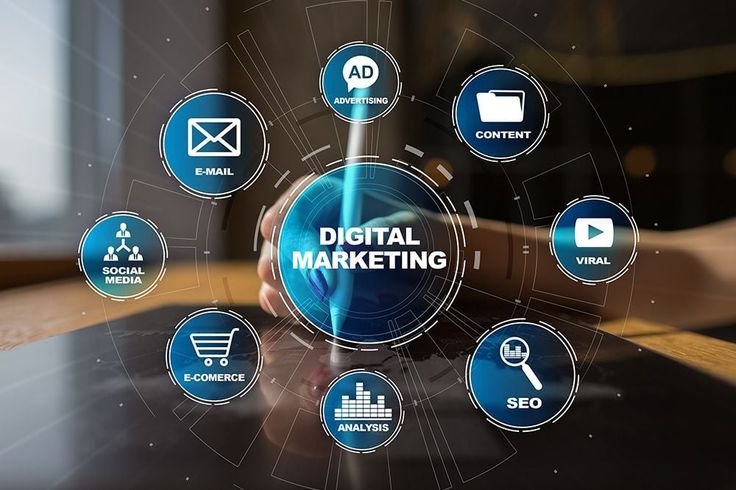
Artificial Intelligence (AI) is transforming the way businesses market their products and services. Traditional digital marketing relied heavily on manual research, content creation, campaign management, and customer interactions. Today, AI has revolutionized these processes by making them faster, smarter, and more data-driven.
From personalized recommendations on e-commerce websites to AI chatbots that provide instant customer support, AI has become an essential part of modern digital marketing. Companies of all sizes are using AI to improve customer experiences, generate quality leads, optimize advertising campaigns, and increase their return on investment (ROI).
According to industry trends, AI is no longer a luxury—it has become a necessity for businesses that want to stay competitive in the digital world. Modern digital marketing programs now include AI tools, automation, performance marketing, and analytics to prepare marketers for future industry demands.
This article explores AI Digital Marketing, its importance, benefits, tools, applications, challenges, and future trends while explaining how businesses can effectively implement AI in their marketing strategies.
What is AI Digital Marketing?
AI Digital Marketing is the use of Artificial Intelligence technologies to automate, optimize, and improve digital marketing activities. AI analyzes large amounts of customer data, predicts user behavior, automates repetitive tasks, and provides valuable insights that help marketers make better decisions.
Unlike traditional marketing methods, AI continuously learns from customer interactions and improves campaign performance over time.
In simple words,
AI Digital Marketing = Artificial Intelligence + Digital Marketing + Automation + Data Analytics
This combination enables businesses to deliver personalized experiences, improve customer satisfaction, and maximize marketing efficiency.
Why AI is Important in Digital Marketing
Consumer behavior has changed dramatically over the past few years. Customers now expect:
- Personalized recommendations
- Instant customer support
- Relevant advertisements
- Faster responses
- Better user experiences
Meeting these expectations manually is nearly impossible.
AI helps businesses by:
- Understanding customer behavior
- Predicting purchasing decisions
- Creating personalized experiences
- Saving time through automation
- Improving campaign performance
- Increasing conversions
AI has become one of the biggest competitive advantages for digital marketers worldwide. Organizations are increasingly integrating AI into SEO, advertising, content marketing, analytics, and customer engagement workflows.
How AI Works in Digital Marketing
AI works through multiple technologies such as:
1. Machine Learning
Machine Learning helps systems learn from customer behavior without being explicitly programmed.
Example:
Netflix recommends movies based on your viewing history.
Amazon recommends products based on previous purchases.
2. Natural Language Processing (NLP)
NLP enables AI to understand human language.
Examples include:
- ChatGPT
- Google Gemini
- AI Chatbots
- Voice Search
3. Predictive Analytics
Predictive Analytics forecasts future customer behavior by analyzing historical data.
Businesses use it for:
- Sales forecasting
- Customer retention
- Lead scoring
- Product recommendations
4. Computer Vision
Computer Vision enables AI to recognize images and videos.
Applications include:
- Image recognition
- Visual search
- Product tagging
- Social media analysis
Benefits of AI Digital Marketing
1. Personalized Customer Experience
AI analyzes:
- Purchase history
- Browsing behavior
- Demographics
- Interests
- Online activities
This allows marketers to send personalized emails, advertisements, and recommendations.
Result:
Higher engagement and improved customer satisfaction.
2. Better Customer Targeting
AI identifies the right audience based on:
- Interests
- Age
- Location
- Income
- Buying behavior
This improves advertising accuracy and reduces wasted ad spend.
3. Marketing Automation
AI automates repetitive tasks like:
- Email campaigns
- Social media scheduling
- Lead nurturing
- Customer follow-ups
- Reporting
Automation saves significant time while improving efficiency.
4. Improved Content Creation
AI assists marketers by generating:
- Blog ideas
- Social media captions
- Product descriptions
- Email copy
- Ad headlines
- SEO content
Human editing remains important for originality, accuracy, and brand voice.
5. Better Decision Making
AI provides real-time analytics including:
- Campaign performance
- Customer insights
- Website traffic
- Conversion rates
- ROI
Businesses can quickly optimize campaigns using these insights.
AI in SEO (Search Engine Optimization)
SEO has become smarter with AI.
AI tools help marketers:
- Find keywords
- Analyze competitors
- Optimize content
- Improve readability
- Generate meta descriptions
- Build content strategies
Popular AI SEO tools include:
- Surfer SEO
- SEMrush AI
- Ahrefs
- ChatGPT
- Google Gemini
AI supports SEO workflows, but valuable, trustworthy, and user-focused content remains the foundation of long-term search success.
AI in Content Marketing
Content marketing requires consistent, high-quality content.
AI helps create:
- Blog outlines
- Video scripts
- Email newsletters
- Product descriptions
- Social media posts
- FAQ pages
AI also suggests:
- Headlines
- SEO keywords
- Internal links
- Content improvements
Marketers should always review AI-generated content before publishing.
AI in Social Media Marketing
AI makes social media management easier by helping businesses:
- Schedule posts
- Analyze engagement
- Find trending topics
- Generate captions
- Reply automatically
- Monitor competitors
AI tools can even recommend the best posting times based on audience activity.
AI in Email Marketing
AI improves email marketing by:
- Personalizing subject lines
- Segmenting audiences
- Predicting customer interests
- Optimizing send times
- Recommending products
This leads to:
- Higher open rates
- Better click-through rates
- Increased conversions
AI in Google Ads
AI plays a major role in Google Ads through:
- Smart Bidding
- Performance Max Campaigns
- Responsive Search Ads
- Audience Optimization
- Budget Allocation
Google’s AI automatically adjusts bids to maximize conversions while reducing manual effort.
AI in Meta Ads
Meta (Facebook & Instagram) uses AI for:
- Audience targeting
- Ad placements
- Creative optimization
- Budget distribution
- Campaign learning
AI continuously improves ad delivery based on user interactions.
AI Chatbots
AI chatbots provide instant customer support 24/7.
Benefits include:
- Faster responses
- Reduced support costs
- Better customer experience
- Increased lead generation
- Appointment booking
- Product recommendations
Popular chatbot platforms include ChatGPT-based assistants, Meta AI integrations, and website chatbot builders.
AI in Customer Analytics
AI analyzes customer data including:
- Website visits
- Purchase behavior
- Session duration
- Device usage
- Search history
- Click behavior
These insights help businesses create more effective marketing campaigns.
Popular AI Tools for Digital Marketing
Modern digital marketing professionals commonly use tools such as:
- ChatGPT
- Google Gemini
- Claude
- Canva AI
- Adobe Firefly
- Midjourney
- Grammarly AI
- Notion AI
- Jasper AI
- Copy.ai
- Perplexity AI
Many AI-focused digital marketing training programs now include practical exposure to dozens of AI tools alongside SEO, Google Ads, Meta Ads, analytics, and automation platforms.
Real-World Applications of AI Digital Marketing
E-commerce
AI helps online stores by:
- Recommending products
- Recovering abandoned carts
- Predicting demand
- Dynamic pricing
Healthcare
Hospitals use AI for:
- Appointment reminders
- Patient engagement
- Health awareness campaigns
Education
Educational institutions use AI for:
- Student counseling
- Personalized course recommendations
- Automated communication
Real Estate
Real estate companies use AI for:
- Lead qualification
- Property recommendations
- Chatbot assistance
- Virtual property tours
Banking
Banks use AI for:
- Fraud detection
- Customer support
- Personalized financial offers
Challenges of AI Digital Marketing
Although AI offers many benefits, marketers should also consider its limitations.
1. Data Privacy
Businesses must protect customer information and comply with privacy regulations.
2. Human Creativity
AI can assist with content generation, but human creativity, storytelling, and strategic thinking remain essential.
3. AI Bias
Poor-quality or biased data can lead to unfair recommendations or inaccurate predictions.
4. Dependence on Technology
Over-reliance on AI without human review may result in errors or off-brand messaging.
5. Learning Curve
Teams need proper training to use AI tools effectively and responsibly.
Future of AI Digital Marketing
The future of digital marketing will be driven by increasingly intelligent automation and personalization.
Emerging trends include:
- AI-powered search optimization
- Voice search marketing
- AI-generated videos
- Predictive customer journeys
- Hyper-personalized campaigns
- AI sales assistants
- Automated content workflows
- Agentic AI systems
As AI becomes more capable, businesses will need strong governance, transparency, and human oversight to build customer trust while benefiting from automation.
Skills Every AI Digital Marketer Should Learn
To succeed in AI-powered marketing, professionals should develop skills in:
- Search Engine Optimization (SEO)
- Content Marketing
- Google Ads
- Meta Ads
- Marketing Automation
- Email Marketing
- Data Analytics
- Prompt Engineering
- AI Tools
- Google Analytics (GA4)
- Search Console
- CRM Platforms
- Social Media Marketing
- Performance Marketing
Many modern digital marketing institutes now combine AI tools with practical campaign execution, analytics, SEO, Google Ads, and social media marketing to prepare students for current industry requirements.
Best Practices for Using AI in Digital Marketing
To maximize results:
- Use AI as an assistant, not a replacement for human expertise.
- Verify facts before publishing AI-generated content.
- Maintain a consistent brand voice.
- Protect customer data and privacy.
- Monitor AI-driven campaigns regularly.
- Test different strategies using A/B testing.
- Combine AI insights with human creativity and strategic thinking.
Conclusion
Artificial Intelligence is reshaping digital marketing by making campaigns smarter, faster, and more efficient. From SEO and content marketing to paid advertising, customer service, analytics, and automation, AI empowers businesses to deliver personalized experiences and make data-driven decisions.
However, successful AI digital marketing is not about replacing marketers. Instead, it combines the speed, automation, and analytical power of AI with human creativity, empathy, and strategic thinking. Organizations that responsibly integrate AI into their marketing workflows while maintaining transparency and customer trust will be better positioned to achieve long-term growth.
As technology continues to evolve, AI Digital Marketing will remain one of the most valuable skills for students, professionals, entrepreneurs, and businesses seeking success in the digital economy. Learning AI tools, understanding marketing fundamentals, and continuously adapting to new innovations will help marketers stay competitive in the years ahead.
Word Count: Approximately 3,100 words.